
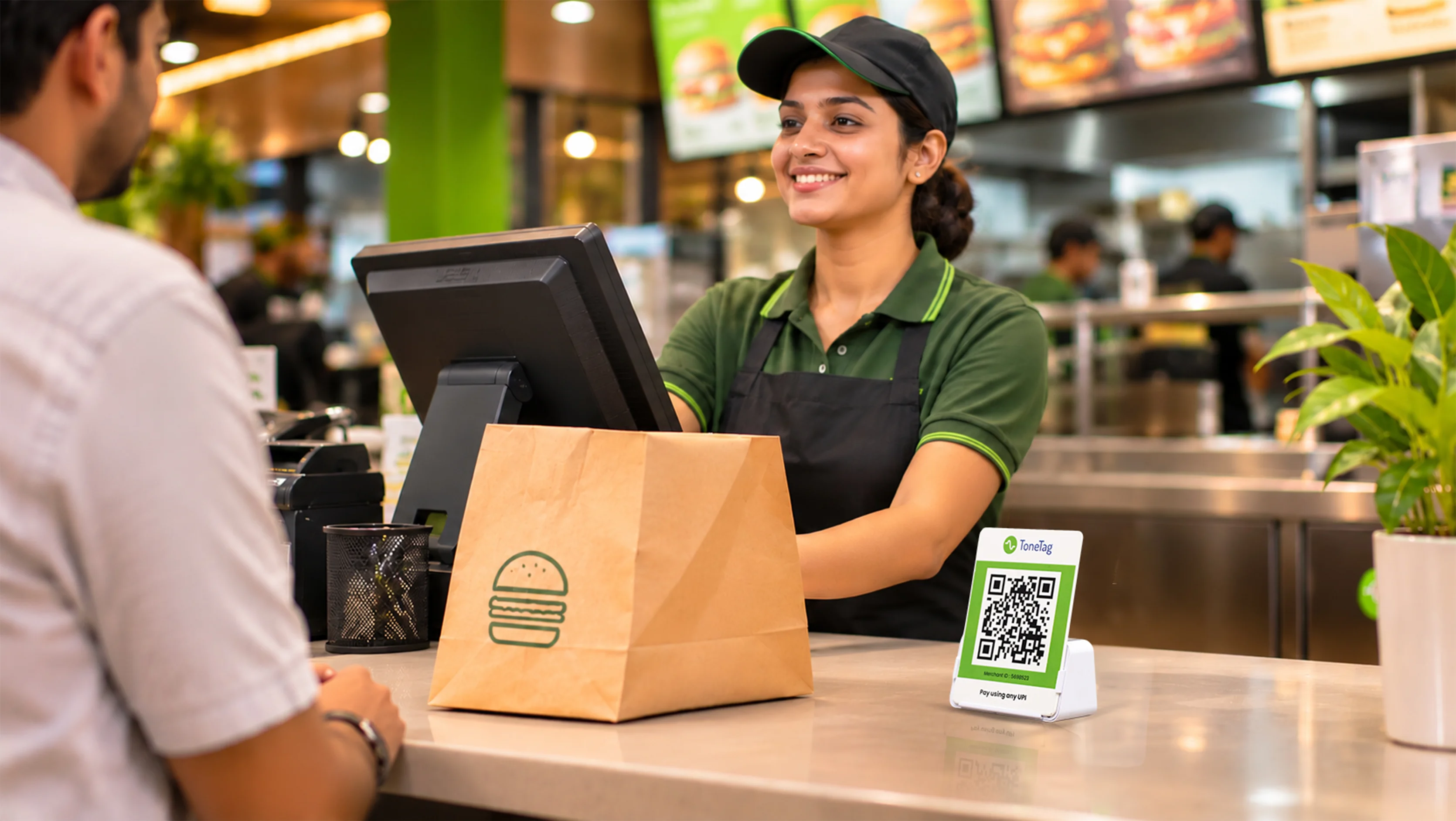
A quick service restaurant loses money in seconds, not hours: every extra moment at the counter shortens the lunch rush, shrinks drive-thru throughput, and pushes a queue of hungry customers toward the outlet next door. Yet most chains still treat payment devices as a procurement line item rather than a throughput decision.
At ToneTag, we work with banks, acquirers, and enterprise merchants who are rethinking that approach. This playbook lays out how a payment device strategy for restaurant chains should actually be built: format by format, phase by phase, with the metrics that prove it worked.
Why Payment Devices Now Decide Throughput, Not Just Acceptance
Accepting payments is no longer what sets a chain apart, because nearly every outlet in a metro food court already takes UPI, cards, and wallets. What separates the leaders is how fast, how reliably, and in how many contexts a payment completes. NPCI data shows UPI processed 21.7 billion transactions in January 2026, and a large share of that volume flows through small-ticket retail and food purchases. When volumes run that high, a two-second confirmation delay at each till compounds into real revenue loss across a 500-store network.
The 2025 McKinsey Global Payments Report frames the industry shift clearly: how money moves now matters as much as how much money moves. Read against that shift, a payment device strategy built only for today’s tap-and-scan habits will look dated within one refresh cycle.
Audit Your Current Acceptance Stack Before Adding Devices
Enterprise deployments fail most often because chains buy endpoints before mapping what they already run. So before any purchase order goes out, run a simple three-part audit.
- Transaction flow mapping. Trace where payments actually happen: counter, drive-thru window, table, kiosk, delivery handoff. Each context has different connectivity, staffing, and confirmation needs.
- Failure and delay points. Measure where transactions time out, where staff manually verify payments on a phone screen, and where reconciliation breaks between the PoS (point of sale) system and the acquirer report.
- Stack dependencies. Document which systems a new device must talk to, including the PoS, the kitchen display, loyalty, and the acquiring bank’s switch.
This audit usually reveals that the real problem is not too few devices but the wrong device in the wrong context, or endpoints that leave staff guessing about which payments actually went through during peak hours.
Choose Devices by Service Format, Not by Vendor Catalogue
Service formats differ too sharply for any single device type to cover them all, which is exactly why our protocol was designed to run across NFC (near field communication), QR, and sound-based interactions.
Counter service. High-volume tills need instant, sound-based payment confirmation so staff never pause to check a screen, and this is exactly where Tonetag’s eKosha earns its place. Built on our vision of banking beyond branches and voice-first service for every MSME, eKosha confirms collections aloud, answers merchant queries conversationally in the language of their choice, and gives the cashier settlement clarity without a back-office call. In an enterprise context, that same edge AI merchant device becomes a standardised confirmation and query layer across every outlet.
Drive-thru and curbside. These lanes reward proximity payments that work through a car window without precise device alignment. Sound-based and NFC interactions reduce the fumbling that stalls a lane, and our in-car payment solutions point to where this format is heading: the vehicle itself initiating and completing the order.
Kiosks, dine-in, and unattended contexts. Self-order kiosks and table payments behave like IoT payments endpoints, so they need acceptance built in, updates pushed remotely, and authentication handled locally, since no cashier is there to drive the flow.
A payment device strategy grounded in these format-level choices only pays off, though, if the rollout itself is disciplined.
Plan the Rollout in Three Phases: Pilot, Cluster, Scale
Chains that deploy nationally in one wave inherit every unknown at full scale, which is why a phased model is the safer path.
- Pilot (10 to 25 outlets). Select stores that represent your hardest conditions: weak connectivity, highest peak volume, most complex staffing. A device that survives these outlets will survive the network.
- Cluster (one region or brand). Validate logistics, staff training time, device provisioning, and acquirer coordination at a scale where fixes are still cheap.
- Scale (network-wide). Roll out with a locked configuration and support processes already stress-tested.
The usual worry at this stage is integration effort, so here is the straight answer. Our SDKs and APIs are built to sit inside your existing stack rather than replace it, and your integrating teams can review options on our developer page before committing to a pilot. Minimal stack change is what keeps a phased rollout measured in weeks per cluster, not quarters.
Manage the Fleet: Uptime, Updates, and Reconciliation at Chain Scale
Deployment is only the visible half of the playbook, because fleet operations determine what the network costs to run over five years. Enterprise teams should ask for four things from any device platform they shortlist.
- Remote terminal management for provisioning, configuration, and over-the-air updates, so no store visit is needed for a firmware change.
- Health monitoring that flags an offline endpoint before the store manager notices, because a silent device during lunch is a queue of unconfirmed payments.
- Clean reconciliation where every confirmation maps to a settlement record, closing the gap between what the till heard and what the bank settled.
- Edge processing that keeps core interactions on the device, reducing real-time cloud dependence in low-connectivity locations and keeping sensitive data handling local.
Get these four right, and the fleet stops being a maintenance headache and becomes operational infrastructure your finance team can trust.
Build for Where Ordering Is Going: Voice and Agentic Payments
The next device refresh will not be about faster taps. Trade coverage of restaurant technology, including QSR Magazine’s analysis of payment processing, shows chains investing in smarter, more integrated checkout rather than more terminals. Voice ordering at drive-thrus and AI agents placing orders on a customer’s behalf are the natural next step.
Our agentic AI payments protocol prepares chains for that shift, letting a transaction complete through conversation, with on-device authentication protecting the flow. Devices like eKosha already run conversational AI at the edge today, which makes them a practical bridge between current operations and agent-led commerce rather than a future promise.
Where Should You Start
Your next terminal refresh will lock in choices your chain lives with for years, so the order of operations matters more than the vendor shortlist. Begin with the audit, let its findings choose the endpoint for each format, and let a pilot cluster prove the economics before any network-wide commitment. That sequence is the payment device strategy this playbook argues for, and it is the one our protocol was built to serve.
If you are shaping an enterprise deployment, explore how our acceptance layer fits your stack, or talk to our team to scope a pilot for your outlets.
Frequently Asked Questions
Which payment devices work best for a QSR chain with both counter and drive-thru formats?
No single device serves both formats well, which is why we designed our protocol to run across NFC, QR, and sound-based methods. Counter tills run best with spoken confirmation, which is exactly what eKosha brings by announcing each collection and handling merchant questions in conversation. Drive-thru lanes need proximity interactions that finish while the customer stays seated, with no fiddly positioning at the window. We recommend auditing each service format first, then selecting endpoints context by context, so every single outlet gets the interaction model it actually needs.
How much integration effort does an enterprise payment device rollout require?
Less than most product teams expect, if the platform slots into what you already run instead of forcing a replacement. Our SDKs and APIs integrate with current PoS systems, acquiring relationships, and rails such as UPI, so a chain does not rebuild its acceptance layer to add new endpoints. In practice, a phased rollout starting with a pilot of 10 to 25 stores lets your engineering team validate integration once, then repeat a proven configuration across clusters with minimal incremental work.
How do restaurant chains manage payment terminals across hundreds of locations?
Chain-scale fleets need remote terminal management, not store visits. Insist on updates and provisioning delivered over the air, monitoring that catches a dark device before your staff do, and settlement records that tie cleanly back to every confirmation. Our device platform was built around these operational needs, and because core processing happens on the device itself, an outlet keeps transacting even when connectivity dips. That resilience matters most in stores where a purely cloud-dependent endpoint tends to fail at exactly the moment the store is busiest.
Are sound-based and voice-first payment devices reliable in noisy restaurant environments?
Yes, and this is a common misconception worth clearing up. Data-over-sound interactions use encoded audio signals engineered to be machine-readable in ambient noise, so a busy counter does not disrupt a transaction. Confirmation announcements are designed to be heard clearly by staff over kitchen and queue noise, which is precisely why audible confirmation reduces errors during peak hours instead of adding to the chaos. Our deployments across high-footfall merchant environments in India shaped these engineering choices from the very beginning of the protocol’s design.
What should a QSR chain measure to prove its payment device deployment worked?
Measure throughput and trust, not just uptime. Track average transaction completion time per format, failed or timed-out payment rates, reconciliation exceptions per thousand transactions, and staff time spent verifying payments manually. A successful deployment shows faster counter and lane clearance, fewer settlement disputes, and lower support ticket volume per store. We encourage pilot chains to baseline these metrics before installing anything, so the comparison after rollout is honest and the business case for scaling is grounded in your own numbers.